Logistics Industry Use Case
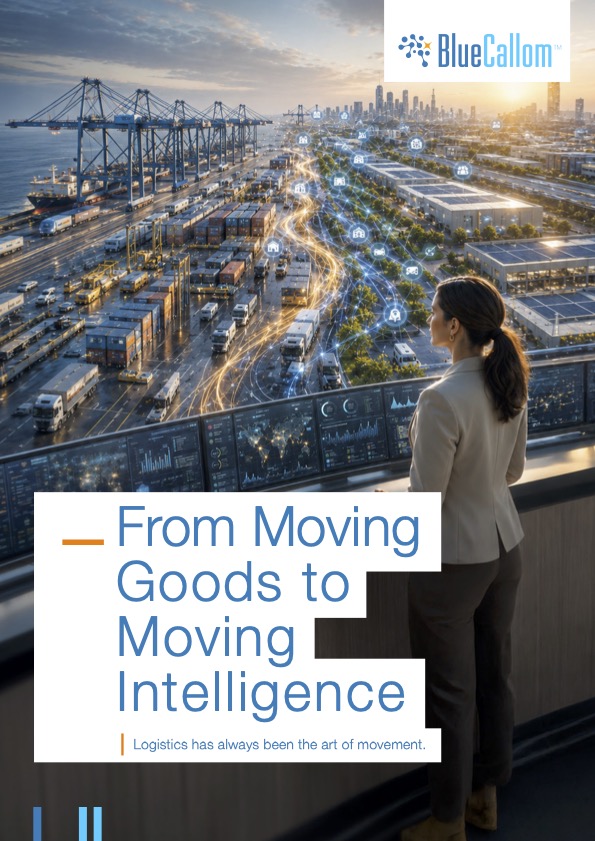
From Moving Goods to Moving Intelligence
April 28, 2026
Logistics has always been the art of movement. Goods move through ports, warehouses, trucks, ships, aircraft, fulfillment centers, customs offices, supplier networks, and customer destinations. But behind every shipment is another kind of movement: information.
For decades, logistics companies optimized vehicles, routes, warehouses, schedules, and systems. Yet the industry still carries a hidden burden: decisions are often made too late, exceptions are handled manually, departments work from different versions of reality, and operational intelligence remains fragmented across the enterprise.
BlueCallom·AI changes the question.
Not only: How can logistics become more efficient?
But: What happens when an entire logistics enterprise begins to think, coordinate, and adapt as one cognitive system?
NOTE: An Enterprise AI implementation unfolds the biggest competitive advantage since the industrial revolution. This is why we cannot expose any details about our customers.
This Logistics Industry Use Case provides a high-level overview of the logistics industry and how BlueCallom·AI can make a major difference.
Use Case Focus
Cognitive coordination across the logistics enterprise.
Possible Impact
Faster exception handling, better operational visibility, proactive customer communication, stronger margin control, and better management decision-making.
Best Fit
Large logistics providers, transportation networks, supply-chain operators, warehouse networks, freight forwarders, carrier networks, and service organizations with complex operational dependencies.
First Recommended Use Case
AI-powered exception management across operations, customer service, finance, and account management.
Transformation Path
Start with one high-value cross-department workflow, prove measurable value, then expand from workflow intelligence to enterprise intelligence.
Current Pressure — Logistics Under Constant Strain
The logistics industry operates in permanent tension.
Customer expectations have risen dramatically. Deliveries must be faster, more transparent, more flexible, and increasingly sustainable. At the same time, logistics providers face volatile fuel costs, labor shortages, customs complexity, geopolitical disruptions, port congestion, capacity fluctuations, weather events, and rising pressure to reduce emissions.
Inside the enterprise, the challenge is equally demanding.
Sales promises delivery performance. Operations manages execution. Procurement negotiates capacity. Warehousing handles inventory flow. Customer service absorbs exceptions. Finance measures margin impact. Management tries to understand what is really happening across all of it.
But each department often works with its own tools, its own data, its own priorities, and its own interpretation of urgency.
A shipment delay may first appear as an operational issue. Then it becomes a customer service issue. Then a financial issue. Then a management issue. By the time the full picture is visible, the company is already reacting.
This is the daily reality of logistics: a business that moves in real time, often managed by systems that explain reality after it has already changed.
Optional visual for section 1
Section Info Box
Add a KPI, note, quote, diagram explanation, or section-specific takeaway.
Current Pressure — Logistics Under Constant Strain
Productivity Ceiling — Why Traditional Digitalization Is No Longer Enough
Most logistics companies are already digital.
They use transport management systems, warehouse management systems, ERP platforms, route optimization tools, fleet tracking, customer portals, dashboards, spreadsheets, email workflows, and reporting systems. These tools are important. They created the first wave of operational efficiency.
But they did not remove the deeper productivity ceiling.
That ceiling exists because traditional software mostly records, routes, reports, and executes predefined logic. It does not truly understand the enterprise context. It does not easily interpret changing priorities across departments. It does not continuously connect operational signals with customer commitments, financial consequences, capacity constraints, and management intent.
As a result, human teams remain the integration layer.
People still read dashboards, interpret alerts, compare spreadsheets, write status updates, chase missing information, coordinate between departments, explain exceptions, and translate operational reality into management decisions.
This is where productivity becomes trapped.
The company may have digital systems, but intelligence still depends on human interpretation at every handover. The enterprise is connected technically, but not cognitively.
And that is the next frontier.
Optional visual for section 2
Section Info Box
Add a KPI, note, quote, diagram explanation, or section-specific takeaway.
Productivity Ceiling — Why Traditional Digitalization Is No Longer Enough
Enterprise AI Potential — From Process Automation to Enterprise Workflow Intelligence
Enterprise AI introduces a fundamentally different capability.
It does not simply automate a task. It can understand context, interpret incomplete information, generate recommendations, coordinate workflows, detect patterns, and support decisions across functions.
In logistics, this means AI can become an intelligence layer above existing systems.
It can observe operational signals from transport, warehousing, customer service, procurement, finance, and planning. It can identify where delays are emerging, which customers are affected, which contracts may be at risk, which routes require re-planning, which warehouses may become congested, and which decisions require human approval.
The important shift is this:
- Traditional software asks users to operate systems.
- Enterprise AI helps systems understand what users are trying to achieve.
- Instead of only managing shipments, the organization begins managing flow.
- Instead of only tracking exceptions, it begins anticipating them.
- Instead of only reporting performance, it begins learning how performance is created.
This is the power of BlueCallom·AI: maximizing AI utilization not as isolated automation, but as Enterprise Workflow Intelligence across the business.
The uploaded framework correctly reminds us that strong use cases need more than a solution description. They must tell the story of the challenge, the approach, the implementation, measurable and qualitative outcomes, and a clear call to action.
At this point, it is important to clarify the BlueCallom approach.
This use case does not attempt to describe the full BlueCallom product portfolio in detail. The reason is simple: the heavy lifting is not done by a single isolated application. It is done by the industry-independent BlueCallom Enterprise AI Platform — the intelligent foundation that enables workflows, agents, applications, and departments to operate in a connected way.
The wide range of possible applications must therefore be discussed individually, in the context of each enterprise: its systems, its processes, its data, its departments, its management priorities, and its ambition for AI utilization.
In logistics, this may begin with exception management, capacity planning, customer communication, warehouse coordination, or margin intelligence. But the strategic point is larger: once the platform is in place, AI utilization can expand across the enterprise, from one workflow to the next, until departmental improvements become a coordinated Cognitive Enterprise.
Optional visual for section 3
Section Info Box
Add a KPI, note, quote, diagram explanation, or section-specific takeaway.
Enterprise AI Potential — From Process Automation to Enterprise Workflow Intelligence
Industry Application — What BlueCallom·AI Could Do for Logistics
In logistics, BlueCallom·AI could become the cognitive coordination layer for the entire operational chain.
Imagine a logistics provider handling thousands of daily shipments across road, rail, sea, air, and warehouse networks. Every shipment produces signals: location updates, ETA changes, customs status, warehouse capacity, driver availability, weather risk, customer priority, cost exposure, and contractual service-level obligations.
Today, these signals often live in different systems.
With BlueCallom·AI, they become part of one intelligent workflow environment.
The system could detect that a container delay in Rotterdam may affect a warehouse slot in Zurich, which may affect a customer installation in Milan, which may affect revenue recognition in finance, which may require proactive communication from customer service.
Instead of waiting for departments to discover the chain reaction, BlueCallom·AI identifies it, explains it, proposes actions, and coordinates the workflow.
- It may suggest rerouting.
- It may generate customer communication.
- It may adjust internal priorities.
- It may alert finance to margin exposure.
- It may help procurement source alternative capacity.
- It may prepare a management summary before the issue escalates.
This is not “AI in logistics” as a chatbot sitting next to operations.
It is logistics becoming intelligent from end to end.
Optional visual for section 4
Section Info Box
Add a KPI, note, quote, diagram explanation, or section-specific takeaway.
Industry Application — What BlueCallom·AI Could Do for Logistics
Cognitive Enterprise Integration — From Departmental Silos to One Intelligent Flow
The greatest productivity gain does not come from improving one department.
It comes when departments stop working as separate islands and begin operating as one cognitive enterprise.
In logistics, this is especially powerful because every department is connected through movement, time, cost, and customer expectation.
A delay is not only a delay.
It is a capacity problem, a customer promise problem, a cost problem, a planning problem, a communication problem, and sometimes a strategic relationship problem.
BlueCallom·AI allows these dimensions to be understood together.
- Operations sees what is happening.
- Customer service sees what it means for the customer.
- Finance sees what it means for margin.
- Procurement sees what it means for capacity.
- Sales sees what it means for the account.
- Management sees what it means for the business.
- This is the birth of the Cognitive Enterprise in logistics.
The enterprise no longer waits for weekly reports, escalation meetings, or manual coordination chains. Intelligence moves with the workflow. Context travels across departments. Decisions become better because they are no longer made from partial views.
The result is not only faster work.
It is a new form of organizational awareness.
Optional visual for section 5
Section Info Box
Add a KPI, note, quote, diagram explanation, or section-specific takeaway.
Cognitive Enterprise Integration — From Departmental Silos to One Intelligent Flow
Departmental Empowerment — How Each Function Benefits
Operations
Operations become less reactive and more predictive.
Instead of manually monitoring thousands of movements, teams receive intelligent exception prioritization. BlueCallom·AI can distinguish between a minor delay and a delay that threatens a key customer commitment. It can recommend alternative routes, flag capacity conflicts, and prepare decision options.
Operations managers move from firefighting to flow orchestration.
Warehouse and Fulfillment
Warehouses benefit from earlier visibility.
If inbound shipments are delayed, warehouse teams can adjust labor planning, dock schedules, picking sequences, and outbound priorities before congestion appears. AI can help balance resources across facilities and identify where inventory movement may become a bottleneck.
The warehouse becomes less of a static facility and more of an adaptive node in the enterprise network.
Customer Service
Customer service changes from apology management to proactive trust management.
Instead of waiting for customers to ask where their shipment is, BlueCallom·AI can generate clear, accurate, context-aware updates. It can explain what happened, what is being done, and what the customer can expect next.
This improves customer confidence and reduces repetitive manual communication.
Sales and Account Management
Sales teams gain early insight into service risks and customer opportunities.
They can see which accounts are affected by recurring logistics issues, which customers may need proactive attention, and where performance improvements can become part of a stronger commercial relationship.
Sales no longer hears about problems only after the customer is frustrated.
Procurement and Carrier Management
Procurement gains better intelligence about capacity, performance, and cost.
BlueCallom·AI can identify carrier reliability patterns, compare actual service performance against commercial terms, and support smarter sourcing decisions. It can help procurement understand not just the lowest cost option, but the best operational and strategic option.
Finance
Finance receives a clearer view of cost-to-serve, margin exposure, claims risk, and operational variance.
Instead of analyzing logistics performance after the month closes, finance can understand financial consequences while decisions are still possible.
This creates stronger management control.
Executive Management
Management gains an integrated view of the logistics enterprise.
Not only KPIs, but explanations.
Not only reports, but emerging patterns.
Not only operational facts, but strategic implications.
Leaders can see where productivity is lost, where AI utilization is rising, where workflows are improving, and where the company can scale intelligence further.
Optional visual for section 6
Section Info Box
Add a KPI, note, quote, diagram explanation, or section-specific takeaway.
Departmental Empowerment — How Each Function Benefits
Management Rationalization — Why the Investment Makes Business Sense
For management, the case for BlueCallom·AI should not be framed only as technology innovation.
It should be framed as productivity economics.
Logistics companies lose enormous value in coordination overhead, exception handling, manual follow-up, delayed decisions, inefficient capacity use, avoidable service failures, poor visibility, and fragmented reporting.
BlueCallom·AI helps rationalize value across several management dimensions.
- It reduces manual coordination work because AI connects signals and prepares decisions.
- It reduces response time because exceptions are detected and interpreted earlier.
- It improves asset and capacity utilization because planning becomes more adaptive.
- It improves customer retention because communication becomes proactive and precise.
- It improves margin control because operational issues are linked to financial consequences.
- It improves employee productivity because teams spend less time searching, checking, explaining, and escalating.
- It improves management quality because leaders operate from a shared intelligence layer.
The ROI logic is therefore not limited to one department.
It emerges from the combined effect of many small productivity gains becoming one enterprise-wide performance shift.
This is where exponential productivity becomes credible: not because one task becomes ten times faster, but because hundreds of workflows across departments become more intelligent, coordinated, and adaptive.
Optional visual for section 7
Section Info Box
Add a KPI, note, quote, diagram explanation, or section-specific takeaway.
Management Rationalization — Why the Investment Makes Business Sense
Transformation Roadmap — Steps to Get There
The path toward a Cognitive Logistics Enterprise should be pragmatic.
It should not begin with a giant transformation program. It should begin with one carefully selected workflow where cross-department intelligence can create visible value.
Step 1: Identify High-Value AI Utilization Opportunities
Start by mapping where human teams spend time interpreting information, coordinating departments, handling exceptions, generating reports, or communicating status.
These are often the best entry points for Enterprise AI.
Step 2: Map Cross-Department Workflow Dependencies
Choose a workflow that touches multiple departments, such as delivery exception management, inbound delay coordination, customer escalation handling, capacity planning, or shipment profitability analysis.
The goal is to find where fragmented intelligence creates measurable friction.
Step 3: Define the First Cognitive Enterprise Use Case
Select a use case with clear business relevance and executive visibility.
For logistics, an excellent first use case could be:
AI-powered exception management across operations, customer service, finance, and account management.
This allows the company to show value quickly because exceptions are frequent, costly, visible, and highly cross-functional.
Step 4: Connect Existing Systems Without Replacing Them
BlueCallom·AI should not be positioned as another disruptive system replacement.
It can work as an intelligent layer that leverages existing data and workflows. This lowers adoption barriers and protects past IT investments.
Step 5: Measure Productivity and Management Value
Measurement should include time saved, faster response cycles, reduced manual communication, lower escalation volume, improved customer transparency, and better management visibility.
Where possible, the story should include robust numbers: hours saved, cost reduction, cycle-time improvement, avoided penalties, or higher capacity utilization.
Step 6: Scale from Workflow Intelligence to Enterprise Intelligence
Once the first workflow proves value, the model can expand.
- From exception management to capacity planning.
- From capacity planning to customer communication.
- From customer communication to profitability management.
- From profitability management to strategic network optimization.
This is how the Cognitive Enterprise grows: not through one massive deployment, but through expanding intelligence across connected workflows.
Optional visual for section 8
Section Info Box
Add a KPI, note, quote, diagram explanation, or section-specific takeaway.
Transformation Roadmap — Steps to Get There
New Reality — The Logistics Enterprise That Learns in Motion
In the new reality, logistics is no longer managed only through tracking and reporting.
- It becomes a living intelligence system.
- Shipments communicate their risk.
- Routes adapt before disruption becomes failure.
- Warehouses prepare before congestion arrives.
- Customer service acts before customers complain.
- Finance sees cost impact before month-end.
- Management understands the enterprise while it is moving.
- The organization becomes faster because intelligence is closer to the work.
- It becomes more resilient because signals are interpreted earlier.
- It becomes more productive because humans are no longer the only bridge between systems.
- It becomes more scalable because workflows learn from repetition.
- It becomes more strategic because operational movement becomes enterprise knowledge.
This is the logistics industry’s next leap. Not simply moving goods faster. But moving intelligence through the enterprise at the speed of business.
Optional visual for section 9
Section Info Box
Add a KPI, note, quote, diagram explanation, or section-specific takeaway.
New Reality — The Logistics Enterprise That Learns in Motion
Call to Action
The logistics industry has spent decades optimizing movement.
Now it can optimize intelligence.
BlueCallom·AI helps logistics companies move beyond departmental automation toward a Cognitive Enterprise — where operations, warehousing, customer service, procurement, finance, sales, and management work from one intelligent flow.
The result is not only efficiency.
It is a new enterprise capability: the ability to sense, understand, coordinate, decide, and improve continuously.
For logistics leaders, the opportunity is clear.
- Do not only digitize the supply chain.
- Do not only automate the department.
- Do not only report what happened yesterday.
Build the enterprise that learns while it moves.
Set it in motion
- Have a conversation with one of our leaders. Scope & Economics.
- Explore the feasibility with our experts. Functionality & Impact.
- Discuss the economics with our project teams. Benefits, ROI, KPIs, Cost.
Call +41 (44) 500-6480
Email contact@bluecallom.com
BlueCallom·AI
Optional visual for section 10
Section Info Box
Add a KPI, note, quote, diagram explanation, or section-specific takeaway.
Call to Action