

GPTBlue AI Solution Builder leverages a unique Multi-Agent Architecture to design your Applications.

Scalable to Corporate AI-Network
Rapid multi-agent application development across your organization without risk of uncontrolled propagation. Securely integrate AI with your CRM, ERP, and other enterprise systems for seamless operations. Extend your AI network to include business partners and suppliers, fostering collaboration and efficiency across your entire value chain.
Multi-Agents Architecture
The BlueCallom·AI Multi-Agents Architecture enables the building, testing, and deployment of complete Enterprise AI Applications. The entire building process is based on our unique Native Agentic AI Design Philosophy.
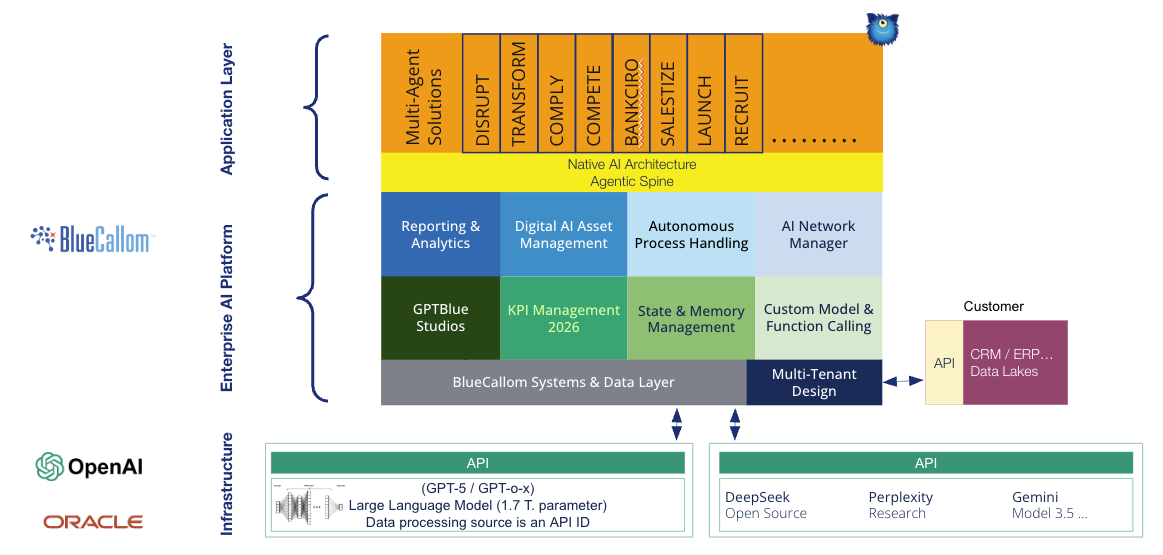
The BlueCallom Agentic AI platform was carefully designed from the ground up as ‘AI-First’ or ‘Native-AI’ design concept. This included the development of unique prompts, agents. and entire multiagent applications. To host those applications in large scale enterprise environments, we created a comprehensive AI Platform, AgenticBlue.
BlueCallom’s multifunctional BluePrompts came to market eight weeks after ChatGPT was introduced. Prompt-to-Prompt communication protocols (Intra Agent Communication, as well as Agent-to-Agent Protocols ensure large scale solution development. Enterprises have the ability to structure prompt and agent design by department or business unit across the globe.
You may want to join one of our upcoming GPTBlue Boot Camps to learn about the full extent of GPTBlue.
Develop – Test – Deploy
.
BlueCallom’s AgenticBlue platform was designed from the ground up as ‘AI-First’ or ‘Native-AI’ design. This included the development of prompts, agents. and entire multiagent solutions.
In early 2023, we had to make a far-reaching decision:
a) Continue with our prompt-led architecture and use code only when the intelligence layer (prompts) requests code-based access to APIs, services, servers, databases, and so forth.
Or
b) Going back to coding and developing all our agents in Python, where the processes are coded in Python and function calls from Python-based process calls the LLM when some intelligence is needed.
At the time, the global development community went with Plan B. It was more comfortable and less expensive.
Yet, we decided to go the hard way and develop a dynamic, adjustable intelligence layer based on specialized prompts, and use code where it is needed anyway, as long as devices, databases, existing systems, APIs, and so forth require code to talk to them.
Today, we know this conscious decision between Code embedded in prompts or prompts embedded in code, was the best decision in the lifetime of the company.
In the GPTBlue Studio, you develop the entire intelligence layer using specialized BluePrompts. BluePrompts are unique multifunctional prompts, almost an agent in itself, which can handle custom model development, Function Calling, conditional prompts, iterative prompts, and more. Should you want to add conventional computer code like Python, ColdFusion, C++ or scripts, you embed it as a function call and use it within a prompt.
Each prompt is built with prompt-objects that help sharpen the prompt and leverage special functions in the Agentic AI solution. Prompts are grouped into autonomous and human interaction prompts, and each prompt type has different functionality.
Testing code is often a nightmare. Code either works to the spec or not at all. But now, you are testing prompts. They almost always work !!! This has to do with its intelligent nature. But they may work ok, good, or brilliantly. Sometimes you need to test out all the edge cases and then decide. For that, we have version control for each prompt. Prompts are composed for agents and agents to multi-agent networks. You can test them in every composition.
Once your Application is tested, you will deploy it to the respective Libraries where users, departments, and entire enterprises maintain their Digital AI Assets.
Unlike simple, conventional prompts used in chat systems and shared as text snippets via email, BluePompts, Agents, and entire Applications are deployed to libraries. In either case, they are executed on the BlueCallom AI Platform. The deployment is the process to bring them into a personal or corporate library or into the BlueCallom or possibly other Exchanges or Marketplaces. There, users can filter between PROMPTS, AGENTS, or SOLUTIONS.
In 2022, GPTBlue was initially developed as an internal development system to create multifunctional prompts for the first version of BlueCallom DISRUPT. Developing, testing, and deploying 128 prompts, and then maintaining all those prompts, could not be done professionally with a text editor. Sooner or later, we shared it with professional prompt designers, business partners, and freelancers. However, due to the rapid pace of AI development and the rapid expansion of the development ecosystem, developers need more and more training to leverage these systems. Integrations, such as API access, third-party server access, ERP, CRM, and SCM access, model development, platform code, and specialized prompts, required a week-long training. The old rule, the simpler the front end, the more effort needs to go into the backend, is still true. Today we make the system available only to trained AI Developers.