Business Service Industry Use Case 2.0
When AI is no longer a competitor
April 28, 2026
Business services have always been built on expertise.
Business services have entered a decisive moment.
For decades, consulting firms, advisory groups, outsourcing providers, agencies, audit teams, engineering service providers, HR service organizations, legal support units, and professional service firms built their value around human expertise.
Clients paid for experience.
They paid for judgment.
They paid for frameworks, analysis, recommendations, transformation programs, project teams, and the confidence that responsible experts stood behind important decisions.
But the foundation of that model is now under pressure.
- AI can analyze.
- AI can summarize.
- AI can generate.
- AI can compare.
- AI can draft.
- AI can structure.
- AI can challenge assumptions.
- AI can create strategy options in minutes.
For many business service teams, this does not yet feel like empowerment. It feels like competition.
And that is the central tension of the industry.
The firms that win will not be the ones that merely buy AI tools. They will be the ones that transform AI from a feared competitor into a trusted amplification system — a holistic Enterprise AI environment that helps human experts think faster, serve better, scale knowledge, protect quality, and deliver superior client value.
BlueCallom·AI changes the question.
Not only: How can business service firms use AI?
But: How can they become Cognitive Enterprises where human expertise and Enterprise AI work as one intelligent delivery system?
Expertise Enters Its Cognitive Era
Business service firms must evolve beyond simple AI adoption and build Enterprise AI environments where human experts and AI work together to accelerate thinking, scale knowledge, protect quality, and deliver superior client value.
Current Pressure — When Expertise Itself Comes Under Pressure
The business services industry is entering one of the most profound transitions in its history.
The pressure is no longer only about margin, utilization, cost, or project speed. It is about the changing value of expertise itself.
The traditional value of being responsible for a client decision is fading. Clients increasingly expect faster answers, broader analysis, lower cost, and AI-enhanced delivery. They no longer accept long cycles of manual research, large teams preparing slides, and expensive document production as naturally as they once did.
At the same time, enterprise complexity has exceeded human comprehension.
A modern client situation may involve global operations, regulatory pressure, fragmented data, cybersecurity exposure, supply chain volatility, workforce transformation, sustainability goals, legacy systems, market uncertainty, and AI disruption — all at once. No individual consultant, no matter how experienced, can manually absorb every signal, dependency, scenario, and implication at the speed clients now expect.
Data complexity is also becoming harder to manage.
Client information lives in interviews, workshops, documents, contracts, reports, spreadsheets, dashboards, CRM systems, project archives, emails, transcripts, prior engagements, and external market signals. The problem is no longer access to information. The problem is converting overwhelming information into decision-ready intelligence.
Solutions need to be developed ever faster.
Proposal cycles are compressed. Strategy teams work under enormous time pressure. Delivery teams must produce insight, structure, documentation, and client-ready recommendations at a pace that traditional operating models were not designed for. Client expectations rise continuously. Knowledge remains scattered across documents, projects, people, emails, tools, and past engagements.
There is also a deeper emotional challenge.
Many teams do not yet experience AI as a partner. They experience it as a threat to their professional identity. They are told to use AI, but they fear it may reduce their relevance. They are asked to adopt it, but they quietly resist it. They see AI being discussed in boardrooms, in restructuring programs, and in productivity targets, and they wonder whether the tool they are expected to use is also the force that may replace them.
That fear is not imaginary. The consulting and professional services sector is already visibly restructuring around AI. Recent reporting has described major AI-related restructuring and thousands of layoffs at firms such as Accenture, while the same firms invest heavily in generative AI capabilities and new AI-driven service revenue streams. BCG has also reported strong growth in AI-related revenue, showing that AI is not a side topic for the industry anymore; it is becoming a core revenue and operating model question.
This creates a dangerous productivity paradox.
Business service firms possess enormous knowledge, but cannot always activate it fast enough. They employ highly capable people, but those people spend too much time searching, assembling, formatting, validating, coordinating, and explaining. They have access to AI, but AI utilization often remains fragmented, uneven, experimental, or emotionally resisted.
The result is not only inefficiency. It is strategic vulnerability.
If AI is treated as a competitor, it will feel like a threat.
If AI is treated as a collection of disconnected tools, it will create confusion.
If AI adoption is left to individuals, utilization will remain uneven.
If AI is not integrated into the operating model, firms will not capture its full productivity potential.
This is exactly where a holistic Enterprise AI system becomes decisive.
The firms that win will not be the ones that merely give employees access to AI tools. They will be the ones that redesign knowledge work around an intelligent enterprise platform — one that helps teams think faster, build better solutions, reuse institutional knowledge, protect quality, and amplify human judgment.
When Expertise Becomes the Bottleneck
Business service firms must move beyond fragmented AI tools and redesign knowledge work around a holistic Enterprise AI system that activates institutional expertise faster, protects quality, and amplifies human judgment under rising client pressure.
Productivity Ceiling — Why Traditional Professional Service Models Are Reaching Their Limit
Business service firms have already optimized many parts of their operating model.
They use CRM systems, project management platforms, time-tracking tools, document repositories, proposal libraries, collaboration platforms, business intelligence dashboards, knowledge bases, workflow systems, and delivery methodologies.
They have built offshore centers, shared service teams, expert networks, industry practices, reusable templates, and quality standards.
These improvements created scale.
But they did not remove the deeper productivity ceiling.
That ceiling exists because the professional services model has historically scaled through people. More projects required more teams. More analysis required more analysts. More client complexity required more senior expert attention. More delivery volume required more coordination.
This model becomes fragile when speed, complexity, and cost pressure rise at the same time.
- A client asks for a strategic recommendation.
- The team searches past work.
- Someone interviews experts.
- Someone reviews documents.
- Someone builds slides.
- Someone validates assumptions.
- Someone aligns with finance.
- Someone checks quality.
- Someone asks a partner to review the story.
- Someone updates the deck again.
Much of this work is valuable. But much of it is also repetitive, reconstructive, and slow.
The firm may already know a lot.
But it cannot always bring that knowledge into the workflow at the moment it is needed.
This is the hidden productivity ceiling of business services: intelligence exists, but it is trapped in fragments.
- A strong client insight may sit in an old strategy deck.
- A reusable framework may live in one project folder.
- A pricing lesson may remain in finance.
- A delivery risk pattern may be with one project manager.
- A senior expert’s judgment may be available only when that person has time.
- A relevant precedent may never be found before the proposal deadline.
Traditional knowledge management tried to solve this by storing documents.
But the issue is no longer storage.
The issue is activation.
Business service firms do not need larger libraries. They need living intelligence systems.
They need AI that can understand context, retrieve relevant knowledge, synthesize complexity, generate options, support decision logic, coordinate teams, and preserve quality — while keeping human experts in control.
From Knowledge Storage to Intelligence Activation
Business service firms must overcome the productivity ceiling of fragmented expertise by turning scattered knowledge, frameworks, precedents, and expert judgment into living AI-powered intelligence that can be activated directly inside the workflow.
Enterprise AI Potential — From AI Resistance to Human Intelligence Augmentation
Enterprise AI creates a new possibility for business services.
It can transform AI from a perceived replacement into a system of human intelligence augmentation.
This is the critical reframing.
AI should not be introduced as a productivity weapon against employees. It should be introduced as a way to multiply the expertise of the organization. It should help consultants, advisors, analysts, project managers, partners, and delivery teams become more capable — not less relevant.
BlueCallom·AI can serve as the intelligent foundation for this shift.
It can help understand client context, synthesize enterprise complexity, compare scenarios, draft proposals, structure strategic options, identify risks, surface reusable knowledge, prepare workshops, generate management summaries, and connect work across departments.
But the value is not simply faster output.
The real value is coordinated intelligence.
A client opportunity is not only a sales record. It connects to prior engagements, industry patterns, expert availability, pricing assumptions, delivery risks, quality standards, and strategic account potential.
A strategy project is not only a consulting engagement. It connects to market data, client interviews, internal knowledge, hypothesis development, financial implications, transformation roadmaps, and executive decision-making.
A project delay is not only a delivery issue. It connects to scope control, staffing, margin, client trust, and future commercial opportunity.
This is Enterprise Workflow Intelligence for business services: AI embedded into the flow of expert work, not added as an external tool.
And here the BlueCallom positioning matters.
This use case does not attempt to describe the full BlueCallom product portfolio in detail. That is intentional. The real heavy lifting is performed by the industry-independent BlueCallom Enterprise AI Platform, which provides the intelligent foundation for connected workflows, agents, and business applications.
Which applications matter most depends on the individual business service company: its service lines, client segments, delivery model, knowledge base, pricing structure, talent capacity, quality standards, data maturity, and management priorities. In business services, the journey may begin with strategy development, proposal intelligence, client onboarding, project delivery support, quality assurance, knowledge reuse, margin analysis, or resource planning.
The broader opportunity is to expand AI utilization step by step across the enterprise — until isolated productivity gains become one Cognitive Business Services Enterprise.
The uploaded framework also reinforces the importance of telling a complete transformation story: from challenge and approach to implementation, measurable outcomes, qualitative impact, and a clear call to action.
Coordinated Intelligence for Expert Work
Enterprise AI enables business service firms to move from isolated productivity tools to connected workflow intelligence, where human experts, reusable knowledge, agents, and business applications work together as one Cognitive Business Services Enterprise.
Industry Application — What BlueCallom·AI Could Do for Business Services
Imagine a global business services firm working with hundreds or thousands of clients across industries.
It has strategy teams, delivery teams, sales teams, project managers, partners, analysts, finance controllers, quality reviewers, HR and staffing managers, knowledge management teams, and executive leadership.
Every day, the enterprise produces signals.
- A client asks for a new strategy.
- A proposal must be created within days.
- A partner needs a market point of view.
- A delivery team discovers scope creep.
- A project manager sees risk emerging.
- A consultant creates a valuable framework.
- A finance team detects margin erosion.
- A staffing manager sees expert overload.
- A quality reviewer identifies weak logic.
- A client executive expects a sharper recommendation.
- A senior consultant fears AI will reduce the value of their role.
In many organizations, these signals remain scattered.
They live in decks, emails, project tools, CRM notes, spreadsheet models, call transcripts, research folders, time reports, client workshops, and people’s memories.
With BlueCallom·AI, these signals can become part of one intelligent workflow environment.
The platform could detect that a new client strategy request resembles several prior engagements, identify relevant internal knowledge, retrieve proven frameworks, suggest expert contributors, generate a first strategic structure, prepare assumptions, identify likely risks, estimate delivery effort, and help management evaluate margin and priority.
It could support a delivery team by summarizing client interviews, structuring problem statements, generating strategic options, preparing workshop agendas, identifying open decisions, and translating raw information into executive-ready narratives.
It could help a project manager monitor progress, detect scope drift, prepare steering committee updates, and connect project status with financial implications.
It could help leadership understand which service offerings scale, where expert bottlenecks appear, where AI utilization is strong or weak, and which teams need support to move from resistance to adoption.
This is not AI as a writing assistant.
It is the transformation of professional expertise into enterprise intelligence.
From Scattered Signals to Enterprise Intelligence
BlueCallom·AI can connect client demands, prior work, delivery risks, staffing pressure, financial signals, and leadership insight into one intelligent workflow environment that turns professional expertise into coordinated enterprise intelligence.
STRATEGYZ Example — Strategy Work as Amplified Intelligence
STRATEGYZ is especially relevant because strategy work is one of the most threatened and most promising areas in business services.
Traditional strategy work depends on senior judgment, structured thinking, market analysis, client interviews, hypotheses, synthesis, scenario development, recommendation logic, and executive communication.
AI can now assist with many of these activities. This creates fear.
If AI can summarize markets, generate options, draft strategy narratives, and build analytical structures, what happens to the strategist?
The answer depends on the operating model. If AI is used as a disconnected tool, it may feel like a replacement for parts of the consultant’s work. But if AI is embedded into a holistic strategy system, it becomes an amplifier of strategic intelligence.
Even in Alpha Version, STRATEGYZ points toward this new model.
It can help teams structure complexity, clarify strategic intent, generate strategic alternatives, accelerate synthesis, prepare decision logic, and turn scattered information into coherent strategic direction. The strategist does not disappear. The strategist becomes more powerful.
Instead of spending so much time collecting, formatting, and reconstructing information, the strategist can focus on judgment, originality, client understanding, decision quality, and transformation logic.
This is the deeper message for business services:
- AI should not replace responsibility for client decisions.
- It should improve the quality of that responsibility.
- AI should not remove human judgment.
- It should give human judgment a larger field of intelligence.
- AI should not turn consulting into commodity output.
It should help firms create higher-value, more adaptive, more evidence-rich client solutions.
STRATEGYZ therefore becomes more than a product example. It becomes a symbol of the shift from defensive AI adoption to amplified strategy work.
Amplified Strategy Work
STRATEGYZ shows how AI can move strategy teams beyond defensive adoption by helping them structure complexity, accelerate synthesis, strengthen decision logic, and expand the power of human judgment in client-facing strategy work.
Cognitive Enterprise Integration — From Expert Islands to Shared Intelligence
Business service firms often grow around expert islands.
- One team knows an industry.
- Another team owns a methodology.
- One partner knows a client deeply.
- One delivery unit has solved a recurring problem.
- One senior consultant has rare expertise.
- One region has developed a strong solution pattern.
- One project created knowledge that others could reuse — if only they knew it existed.
This model works when a firm is small.
But as the organization grows, expertise becomes harder to mobilize. Knowledge becomes unevenly distributed. Some teams recreate what others already know. Some experts become overloaded. Some client opportunities are won or lost depending on who happens to be available.
BlueCallom·AI helps turn these expert islands into a shared intelligence system.
- Sales can access delivery knowledge earlier.
- Delivery can reuse proven methods faster.
- Strategy teams can synthesize complexity more effectively.
- Finance can understand margin drivers during the project, not after it.
- HR can match talent to demand more intelligently.
- Quality can review outputs against standards and past success patterns.
- Management can see how knowledge flows — or fails to flow — through the enterprise.
- This is the Cognitive Business Services Enterprise.
- It does not replace human expertise. It amplifies it.
- The consultant remains essential.
- The advisor remains accountable.
- The project leader remains responsible.
- The partner still owns the relationship.
- The executive still makes strategic decisions.
But the organization no longer depends solely on human memory, manual search, informal networks, and overworked experts to activate its intelligence.
The enterprise itself begins to remember, suggest, connect, and learn.
From Expert Islands to Shared Intelligence
BlueCallom·AI helps business service firms connect isolated expertise, reusable knowledge, delivery experience, financial insight, talent capacity, and quality standards into a Cognitive Business Services Enterprise that remembers, suggests, connects, and learns.
Departmental Empowerment — How Each Function Benefits
Strategy and Advisory Teams
Strategy teams gain a new operating model.
BlueCallom·AI and STRATEGYZ can help structure complex client situations, organize hypotheses, compare strategic options, prepare decision frameworks, and accelerate synthesis.
This does not remove the strategist’s role. It changes the strategist’s leverage.
The team spends less time assembling raw material and more time improving the quality of thinking.
Strategy becomes faster, broader, more adaptive, and more evidence-rich.
Sales and Business Development
Sales teams gain better preparation and stronger client relevance.
BlueCallom·AI can help analyze client context, identify similar past engagements, assemble relevant proof points, suggest solution structures, prepare proposal drafts, and highlight delivery risks before commitments are made.
This allows sales to move faster without becoming generic.
The proposal becomes less of a document assembly exercise and more of an intelligent response to client intent.
Client Delivery Teams
Delivery teams benefit from active knowledge reuse.
Instead of starting from blank pages or searching through old folders, teams can access relevant methods, templates, insights, lessons learned, and deliverable structures.
BlueCallom·AI can help summarize client information, prepare workshops, draft deliverables, track decisions, and identify emerging risks.
Delivery becomes more consistent, faster, and more scalable.
Experts spend less time reconstructing known solutions and more time applying judgment where it matters.
Project Management
Project managers gain stronger visibility and earlier risk detection.
BlueCallom·AI can help monitor project status, summarize team updates, detect missing inputs, identify scope creep, prepare steering committee materials, and connect delivery progress with budget and margin implications.
Project management shifts from administrative tracking to intelligent orchestration.
The project manager becomes less of a status collector and more of a momentum manager.
Knowledge Management
Knowledge management becomes active rather than passive.
Instead of simply storing documents, BlueCallom·AI can classify, summarize, connect, and recommend knowledge assets in the context of current work.
It can identify which materials are reused, which are outdated, which are valuable, and which knowledge gaps are emerging.
The knowledge base becomes less of a library and more of a living intelligence system.
Quality Assurance
Quality teams gain better consistency and faster review capability.
BlueCallom·AI can help compare deliverables against internal standards, client requirements, previous successful work, regulatory expectations, or brand language.
It can identify missing sections, weak arguments, inconsistent assumptions, unsupported claims, and unclear recommendations.
Quality review becomes less dependent on late-stage correction and more embedded in the workflow.
Human Resources and Talent Allocation
HR and staffing teams gain better intelligence about capability, availability, and demand.
BlueCallom·AI can help match people to projects based on skills, experience, language, industry knowledge, workload, development goals, and client needs.
It can also identify where the organization is becoming dependent on too few experts.
Talent allocation becomes more strategic.
The firm does not only assign capacity. It develops intelligence about capability.
Finance and Controlling
Finance gains earlier visibility into margin and delivery economics.
BlueCallom·AI can connect proposal assumptions, staffing plans, delivery hours, scope changes, project risks, billing models, and client profitability.
Instead of discovering margin erosion after the fact, finance can support better decisions while projects are still active.
Finance becomes a partner in value creation, not only performance reporting.
Leadership and Management
Management gains a clearer view of the firm as an intelligence system.
Leaders can see which services scale, which teams are overloaded, which clients are profitable, which knowledge assets create value, which proposals consume too much effort, where AI adoption is resisted, and where AI utilization improves performance.
The executive conversation changes.
Not only: “How many hours did we bill?”
But: “How intelligently did we use our expertise?”
Enterprise AI Across Every Function
BlueCallom·AI empowers strategy, sales, delivery, project management, knowledge, quality, HR, finance, and leadership teams by turning fragmented expertise into coordinated intelligence that improves speed, consistency, decision quality, resource allocation, and enterprise performance.
Management Rationalization — Why the Investment Makes Business Sense
For business service leaders, the case for BlueCallom·AI should be framed around expertise multiplication, margin protection, AI utilization, cultural adoption, and strategic survival.
The largest productivity losses in business services are often invisible.
They appear as repeated proposal work, duplicated research, slow onboarding, senior expert bottlenecks, excessive internal coordination, inconsistent delivery quality, project overruns, underused knowledge assets, and late recognition of margin erosion.
But now there is another cost: AI resistance.
If employees avoid AI because they see it as a threat, the firm loses twice.
It loses productivity potential.
And it loses time in an industry where competitors are already redesigning delivery around AI.
This is why a holistic platform matters.
BlueCallom·AI helps rationalize value across several management dimensions.
It can reduce proposal effort by reusing relevant knowledge intelligently.
It can increase delivery productivity by providing teams with contextual methods and assets.
It can improve strategic work through tools such as STRATEGYZ, where complexity can be structured and transformed into better client options.
It can improve quality by embedding review and consistency checks into workflows.
It can protect margin by identifying scope, staffing, and delivery risks earlier.
It can reduce dependency on scarce senior experts by making institutional knowledge more accessible.
It can improve client responsiveness by accelerating research, communication, and deliverable preparation.
It can strengthen management insight by connecting sales, delivery, finance, quality, staffing, and leadership into one intelligence layer.
It can reduce cultural resistance by making AI part of a trusted enterprise workflow rather than a threatening external tool.
The ROI logic is not limited to one function.
It emerges from the combined effect of many knowledge workflows becoming faster, smarter, more reusable, and more trusted.
- One AI-assisted proposal may save time.
- One AI-supported project may improve margin.
- One AI-enhanced strategy workflow may improve the quality of a client decision.
But when these capabilities connect across strategy, sales, delivery, project management, finance, HR, quality, and leadership, the firm begins to change its productivity model.
That is where exponential productivity becomes credible.
The organization no longer scales only by hiring more people. It scales by increasing the utilization of its collective intelligence.
Scaling Collective Intelligence
BlueCallom·AI makes business sense by helping service firms multiply expertise, protect margin, increase AI utilization, reduce cultural resistance, and shift growth from adding more people to activating collective intelligence across the enterprise.
Transformation Roadmap — Steps to Get There
The path toward a Cognitive Business Services Enterprise should be practical, credible, and human-aware.
It should not begin with a vague “AI transformation” program. It should begin with a workflow where knowledge work is frequent, costly, visible, and cross-functional.
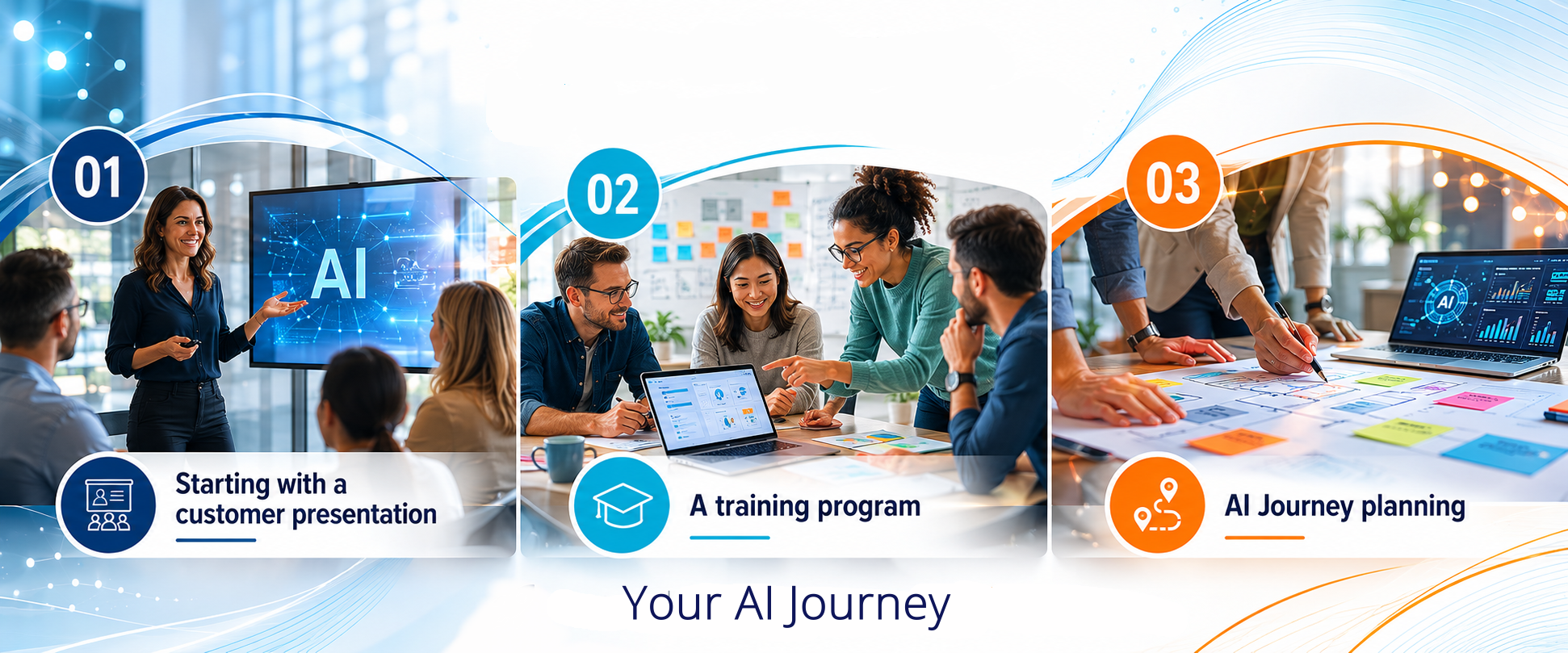
Step 1: Identify Where AI Is Feared, Avoided, or Underused
Before selecting a workflow, management should understand the emotional reality.
- Where do teams avoid AI?
- Where do experts feel threatened?
- Where is AI used only superficially?
- Where is adoption blocked by trust, quality, confidentiality, or professional identity concerns?
This matters because the goal is not only technical deployment.
The goal is AI utilization.
Step 2: Identify High-Value AI Utilization Opportunities
Map where teams spend time searching, drafting, reviewing, coordinating, reporting, estimating, staffing, synthesizing, or recreating knowledge.
Strong candidates include strategy development, proposal creation, client onboarding, project documentation, deliverable creation, quality review, staffing decisions, margin monitoring, and management reporting.
Step 3: Map Cross-Department Dependencies
Select workflows where one activity affects several functions.
- A strategy project touches partners, consultants, research, delivery, finance, quality, staffing, and management.
- A proposal touches sales, delivery, finance, legal, staffing, and executive review.
- A client project touches delivery, project management, quality, finance, HR, and account leadership.
These workflows are ideal for Enterprise Workflow Intelligence.
Step 4: Define the First Cognitive Enterprise Use Case
A strong starting point for business services could be:
AI-powered strategy and proposal intelligence across sales, strategy teams, delivery, finance, staffing, quality, and management.
This use case is powerful because strategy and proposal work are frequent, expensive, knowledge-intensive, client-visible, and directly connected to revenue and margin.
It also creates an ideal stage for STRATEGYZ.
The organization can demonstrate that AI does not replace strategic thinking. It amplifies it.
Step 5: Connect Existing Knowledge and Systems Without Replacing Them
Business service firms already have CRM systems, document repositories, project tools, finance systems, collaboration platforms, and knowledge bases.
The goal is not to replace them.
BlueCallom·AI can work as an intelligent platform layer that connects, interprets, and activates the knowledge already present in the enterprise.
The platform helps the organization understand what it knows — and how to use it in the moment of work.
Step 6: Build Trust Through Governed AI Workflows
AI adoption in business services requires trust.
Teams need to know where information comes from, how outputs are generated, what assumptions are used, which sources are relevant, and where human approval is required.
A governed Enterprise AI Platform can make AI safer, more transparent, and more acceptable than uncontrolled individual tool usage.
This is essential for firms whose reputation depends on quality, confidentiality, and client trust.
Step 7: Measure Productivity, Quality, and Adoption
Measurement should include reduced proposal creation time, faster strategy synthesis, shorter onboarding, fewer duplicated efforts, improved delivery consistency, reduced senior expert dependency, better margin visibility, fewer project escalations, improved quality review cycles, and higher reuse of knowledge assets.
But measurement should also include AI utilization itself.
- Which teams use it?
- Where does adoption rise?
- Where does resistance remain?
- Which workflows benefit most?
- Which experts become stronger through AI support?
The first project should produce a management story that is operationally credible, financially meaningful, and culturally encouraging.
Step 8: Scale from One Workflow to Enterprise Intelligence
Once the first workflow proves value, the model can expand.
- From strategy intelligence to proposal intelligence.
- From proposal intelligence to client onboarding.
- From client onboarding to delivery support.
- From delivery support to quality assurance.
- From quality assurance to staffing intelligence.
- From staffing intelligence to margin control.
- From margin control to strategic service portfolio management.
This is how the Cognitive Business Services Enterprise grows.
Not as a single transformation event, but as a disciplined expansion of intelligence across workflows.
From Workflow Pilot to Cognitive Enterprise
Business service firms can build a Cognitive Business Services Enterprise by starting with high-value AI workflows, addressing trust and adoption, connecting existing systems, measuring business impact, and scaling intelligence step by step across the organization.
New Reality — The Firm That Learns While It Serves
In the new reality, the business services firm is no longer managed only through billable hours, project plans, proposal decks, utilization reports, and partner reviews.
- It becomes a learning enterprise.
- Every client conversation strengthens future understanding.
- Every proposal improves the next proposal.
- Every strategy engagement enriches institutional intelligence.
- Every project risk improves future delivery.
- Every quality review raises the standard.
- Every staffing decision improves capability insight.
- Every margin signal informs better commercial judgment.
- Every expert contribution becomes more reusable across the firm.
- AI no longer appears as the competitor.
- It becomes the operating layer through which human expertise is amplified.
- The enterprise becomes faster because knowledge is activated at the point of work.
- It becomes more scalable because expertise is no longer trapped in individuals or teams.
- It becomes more profitable because margin risks are detected earlier.
- It becomes more consistent because quality is embedded into workflows.
- It becomes more trusted because AI is governed, contextual, and connected to human responsibility.
- It becomes more strategic because management sees how intelligence flows through the business.
- This is more than knowledge management.
- It is cognitive professional service delivery.
A firm that does not only serve clients with expertise, but continuously learns from every act of service.
Learning Through Every Client Engagement
A Cognitive Business Services Enterprise turns every conversation, proposal, project, quality review, staffing decision, and margin signal into reusable intelligence, enabling the firm to serve clients better while continuously learning from every act of service.
Call to Action
The business services industry is being reshaped by AI.
Some firms will experience this as erosion: fewer people, shrinking margins, faster commoditization, and declining value for traditional delivery models.
Others will turn this moment into reinvention.
BlueCallom·AI helps business service organizations move beyond fragmented AI tools, scattered knowledge, manual coordination, and emotional resistance toward a Cognitive Enterprise — where strategy, sales, delivery, project management, knowledge management, HR, quality, finance, and leadership operate through one intelligent flow.
The result is not only efficiency.
It is a new enterprise capability: the ability to sense client intent, activate institutional knowledge, coordinate expert work, protect margin, improve quality, and learn continuously from every engagement.
For business service leaders, the opportunity is clear.
- Do not let AI become the competitor.
- Do not leave adoption to chance.
- Do not reduce transformation to disconnected tools.
- Do not ask teams to use AI while they fear what it means.
- Build the firm where AI amplifies expertise.
Set it in motion
- Have a conversation with one of our leaders. Scope & Economics.
- Explore the feasibility with our experts. Functionality & Impact.
- Discuss the economics with our project teams. Benefits, ROI, KPIs, Cost.
Call +41 (44) 500-6480
Email contact@bluecallom.com
BlueCallom·AI
Turn AI Pressure Into Enterprise Reinvention
BlueCallom·AI helps business service leaders move beyond fragmented tools and AI resistance toward a Cognitive Enterprise that activates institutional knowledge, coordinates expert work, protects margin, improves quality, and continuously learns from every engagement.