
Pay for Gain
Enterprise AI economics tie cost to measurable productivity gains while eliminating subscriptions, licenses, update fees, and upgrade costs.
BlueCallom’s Enterprise-AI-level Pay-for-Gain business model is designed to align the economics of Enterprise AI with the productivity gains it creates.
Unlike traditional software models based on user subscriptions, application licenses, feature packages, maintenance contracts, and upgrades, Pay-for-Gain is based on the measurable value generated by Enterprise AI workflows.
BlueCallom measures the productivity contribution of every step within an AI-supported workflow. In larger Enterprise AI applications, this can involve hundreds or thousands of individual AI activities. The resulting productivity gain and associated cost are continuously calculated and displayed through a real-time ROI meter.
The result is a fundamentally different economic relationship between customer and technology provider:
The more value the AI creates, the more valuable it becomes for both.
From SaaS to Pay-for-Gain
BlueCallom founder Axel Schultze was already building a SaaS company in 1999, at approximately the same time Salesforce was founded and before Software-as-a-Service became an established industry term.
More than two decades later, BlueCallom initially started with a SaaS business model in 2021. However, the company abandoned the model only a few months later. The reason was economics rather than technology.
User-based subscriptions financially discourage companies from giving every employee access to a system. Application licenses encourage organizations to limit functionality. Upgrade fees make customers postpone technological advancement. Yet Enterprise AI benefits from exactly the opposite: broad adoption, extensive usage, continuous improvement, and access to the most advanced capabilities available.
For BlueCallom, this created a contradiction.
A business model for Enterprise AI should encourage customers to maximize productivity — not encourage them to minimize licenses.
The AI Flight Becomes the Economic Unit
BlueCallom calls the complete execution of an Enterprise AI workflow an AI Flight.
A Flight begins when a workflow is initiated and ends when its intended outcome has been reached. Depending on the application, a Flight may contain hundreds or thousands of individual steps, AI agents, decisions, interactions, and autonomous activities.
Each of those activities can contribute to productivity gain.
By measuring these gains across thousands of executions, BlueCallom can establish minimum, maximum, and average productivity gains for different Flights and continuously improve the economics of its applications.
Instead of asking, “How many users do you have?”, the economically relevant question becomes:
“How much productivity did this Flight generate?”
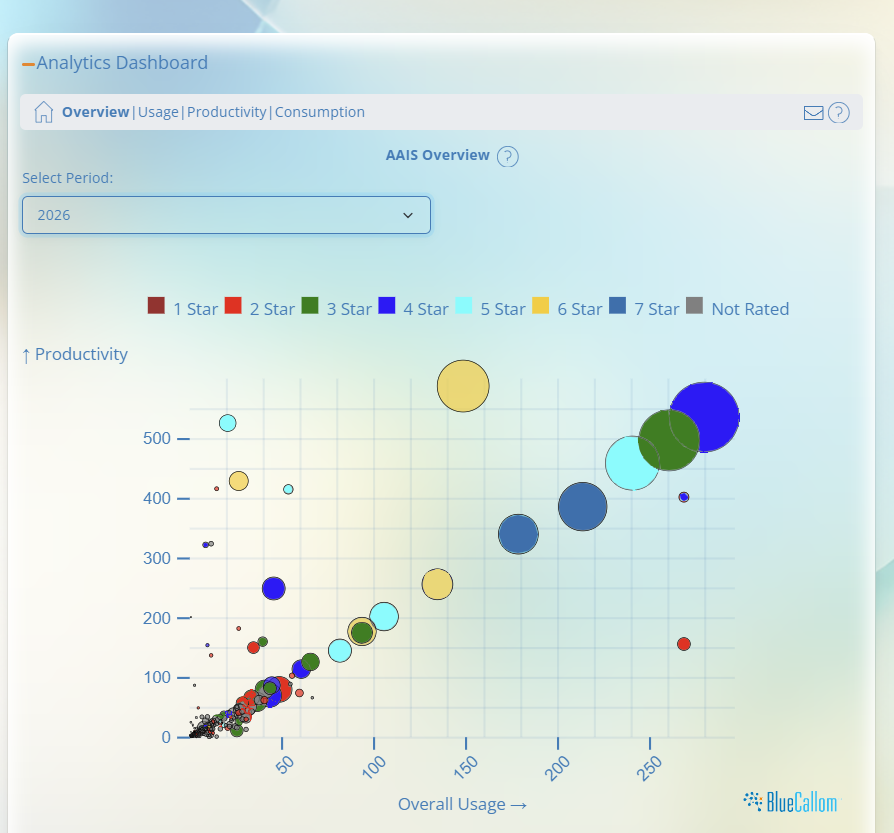
Image Description
Shows immediately the relationship between USAGE (x-Axsis), PRODUCTIVITY (y-Axis),
COST (Circle Size), and USER-RATING (Color Code),
for every active AI-Application or Agent (AI-Assets).
Real-Time ROI Makes the Gain Visible
A central element of Pay-for-Gain is BlueCallom’s newly introduced real-time ROI meter.
Customers can see the cost of their Enterprise AI usage alongside the productivity gain generated by it. As Flights are executed, the economic performance of Enterprise AI becomes visible rather than remaining an assumption made during a software purchasing process.
This changes Enterprise AI economics from projected ROI to measurable ROI.
Rather than calculating a theoretical business case before purchasing software and reviewing it months later, organizations can continuously see how their Enterprise AI investment performs.
Pay-for-Gain turns AI ROI from a promise into a continuously measured business metric.
Pay-for-Gain or Fixed Price per Flight
BlueCallom has now extended the model for organizations requiring predictable budgets.
Customers can choose between the original Pay-for-Gain model and a predefined fixed price per Flight.
Even under fixed pricing, BlueCallom continues to calculate and display the underlying Pay-for-Gain economics. Customers therefore retain visibility into the actual productivity gain and can see the economic difference between the two models.
They can switch between the models as their requirements change. This combines predictable budgeting with transparent Enterprise AI economics.
For BlueCallom, the transition is therefore not simply from SaaS to another pricing model.
From paying for software.
To paying for usage.
To paying for gain.
Delivery Model
The way we deliver solutions in the AI-World has also changed profoundly. The old “Tech Stack” was Cloud-based hardware, and on top ran software that was accessible via a browser. This two-layer stack is today a four- or even five-layer Industry-Stack. Complexity, engineering capabilities, and to a large degree capital have widened and specialized the stack.
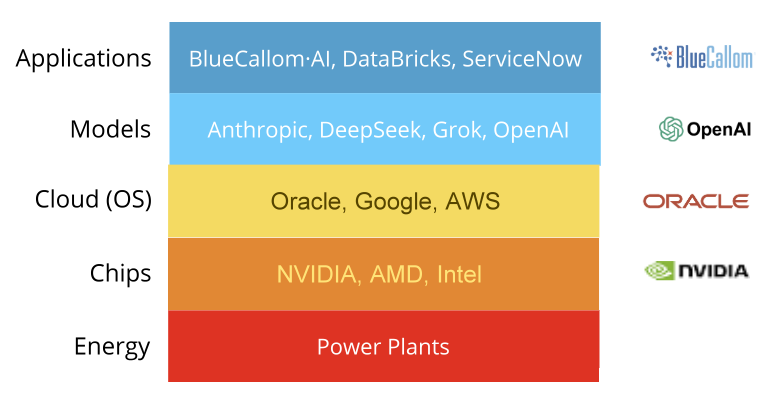
1) Energy consumption is now a big deal.
2) The base hardware, such as GPUs, is so complex these days that Hardware vendors like NVIDIA need a company like TSMC that builds it for them. And even TSMC needs ASML to help prepare the production.
3) Now running a hyperscaler like Google, AWS, or Oracle needs powerful hardware and needs to make sure that thousands of enterprises are safe running their business in the cloud. The sheer scale of the operation can’t be afforded by even the biggest organizations. Many would rather not play than give their data out of hand – just because they fear theft. Yet any local IT is many times more vulnerable than those big organizations.
4) On top of the Hyperscalers, the biggest AI firms run their models. There are currently 60 different LLMs on the market, including the ‘Big 5’: Anthropic, DeepSeek, Grok, OpenAI, and Google. These are the operating systems for AI Applications.
5) And the final layer is the Application Layer. Here is BlueCallom at home. Building Native AI Enterprise AI architecture and applications since 2022.
Our Delivery Hierarchy
With that significant evolution in the industry stack, we understood that the delivery model will change too. We are no longer just charging for software but also for the actual Intelligence Operating System on Level 4 and for the cloud infrastructure and security on Level 3, with that getting access to ultra-high-performance GPU systems on Level 2, who also have access to the much-needed energy from Level 1.
Delivery Value Model
The biggest value we gain from this model is focusing 95% on building the best possible Enterprise AI Solutions and collaborating with the other heavyweights on security, infrastructure, performance, data models, universal artificial intelligence, and optimization.
Full Service Means Continuous Advancement
BlueCallom has also decided to make Pay-for-Gain a full-service model. Updates, improvements, and upgrades to BlueCallom’s Enterprise AI applications are included. Customers are not asked to purchase a new software generation simply because the technology has advanced.
This is particularly important in AI.
Enterprise AI technology is developing too rapidly for traditional software upgrade cycles. Models improve, architectures evolve, workflows become more intelligent, and new capabilities emerge continuously. BlueCallom therefore considers technological advancement part of operating the service rather than a separate product to be sold later. The Pay-for-Gain model also gives BlueCallom an economic incentive to invest where applications are used most and where improvements can generate the greatest additional customer value.
The interests of vendor and customer become naturally aligned:
Customers want greater productivity gain. BlueCallom benefits by creating greater productivity gain.
Enterprise AI Requires Enterprise AI Economics
For decades, software economics were built around ownership and access: licenses, seats, modules, versions, maintenance, and upgrades. Cloud computing transformed much of that model into subscriptions, but the fundamental economic unit remained access to software.
Enterprise AI introduces far more possibilities.
Its contribution can increasingly be measured by the work it performs and the productivity it creates. BlueCallom believes this will lead to a broader shift in enterprise technology economics.
Enterprise AI gives us something conventional could not provide at this scale: the ability to measure the economic contribution of thousands of intelligent activities. Once you can measure the gain, charging for access to the technology no longer makes much sense. Pay-for-Gain aligns everybody around what actually matters — the business outcome.”
Summary
To sum it up, things get substantially easier and significantly more intelligent. The world economy would have never allowed air traffic, logistics, mobility, manufacturing, and comfort like we have today. And this new world of AI is by order of magnitude more powerful than the Industrial Revolution 200-300 years ago. And the complexity to get there continues to grow. Even in tiny aspects like product pricing and delivery models.