

End of Data Cleansing for AI
End Of Data Cleansing for AI
You will be surprised by what our research found out
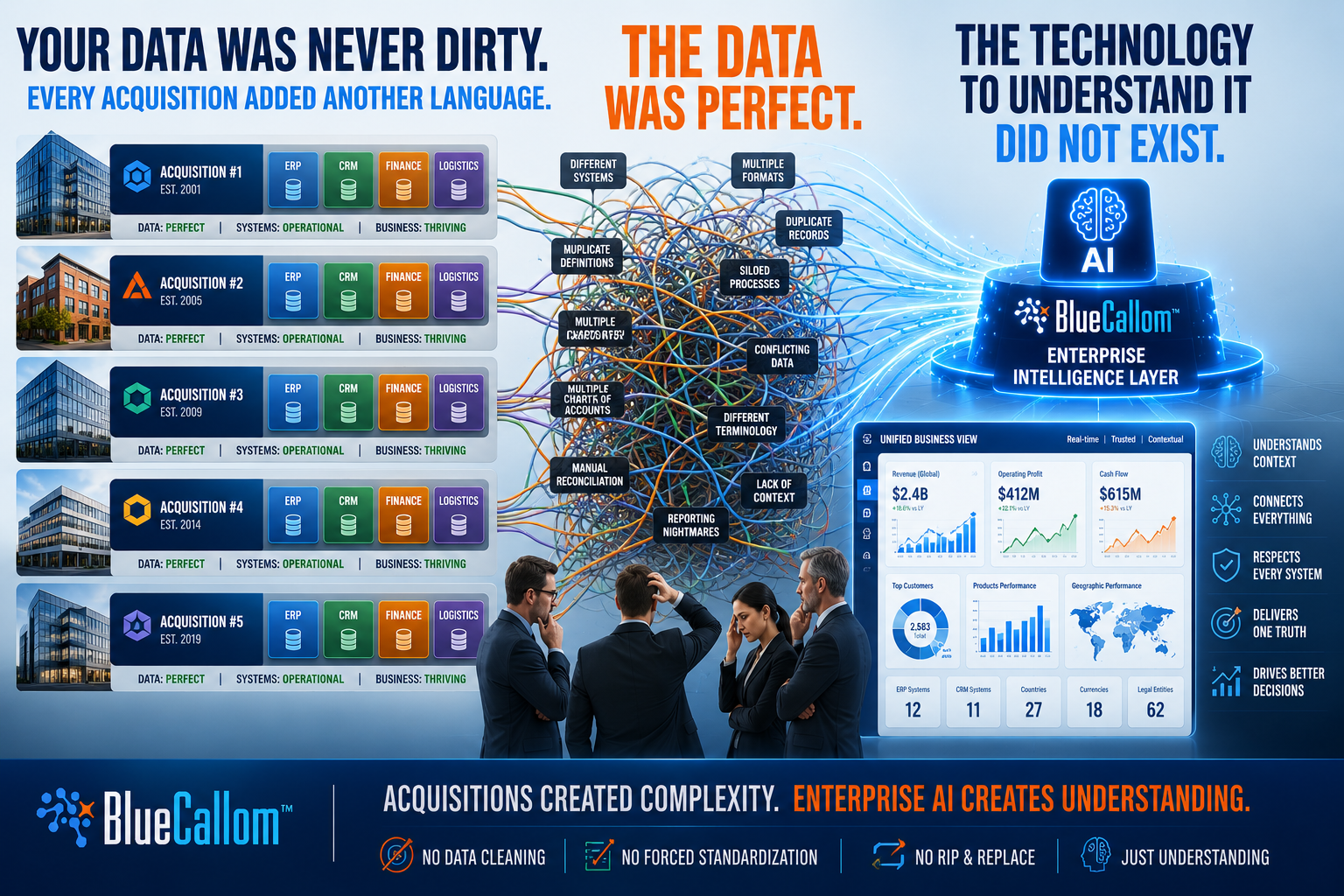
For years, businesses have been told the same thing: “Before you can successfully implement AI, you must clean your data.” Consultants, software vendors, and technology experts repeated the message so often that it became accepted wisdom. At first glance, it makes perfect sense.
If your databases contain duplicates, inconsistencies, missing information, and conflicting records, wouldn’t AI simply amplify those problems? We believed that too. Until we started asking a different question.
The Question Nobody could answer:
Why have Fortune 1000 companies—with billions invested in technology, world-class consultants, and generations of software systems—not eliminated their data chaos? Why has no software vendor solved it? Why has no Silicon Valley startup cracked the code?
During a finance conference, a computer scientist from ETH Zürich, had a surprisingly simple answer:
“Because the problem is not solvable with computer software.”
That statement changed our thinking.
Is there really data chaos?
Consider a few common scenarios.
Scenario 1: The Typo Problem
A customer creates an account as “BlueCallom.” Later, someone places another order and accidentally enters “BlueCallum.” Now there are two customer records, two order histories, two transaction trails, and two versions of reality. Multiply that across thousands of customers and years of operation. The result is what most companies call “data chaos.” Yet, even with conflicting data, the data itself may not be bad.
Scenario 2: The Acquisition Problem
Company A acquires Company B. Both organizations have product catalogs. Unfortunately, SKU 123456 means “Wheel Assembly” in one company and “Windshield Wiper” in the other. Behind those two records are years of purchase histories, supplier relationships, inventory movements, customer transactions, and financial records. Which one should be changed? And what happens to the thousands—or millions—of transactions connected to it?Yet even with conflicting data, the individual data points themselves are accurate.
Scenario 3: Human Reality
Typos. Misspellings. Different naming conventions. Language differences. Abbreviations. Human beings generate data in countless ways, and every variation becomes part of the system. Ofcource, the data cause conflicts and irritation, but a single mistake does not make it bad. It only makes it useless for non-intelligent software.
Scenario 4: Business Evolution
Organizations continuously evolve. Processes change. Departments merge. Products are redefined. Business models adapt. What appears to be a minor operational adjustment often creates major structural consequences inside databases. Also, here the data were typically correct at a given point in time, but were no longer useful to the software that processes them.
Scenario 5: The Billion-Euro Question
One pharmaceutical company considered a complete redesign of its processes and data structures. A consulting firm proposed a project approaching one billion euros. The company was willing to proceed—under one condition:
“Can you guarantee this design will still work for the next ten years?”
The consulting firm could not. And rightly so.
This scenario, in particular, reveals the full extent of the real problem: We may have looked at the data from such a narrow perspective that we could not see the underlying problem. Yet, it took us 4 years to come up with a solution.
What If Data Isn’t the Problem?
Eventually, we began questioning a fundamental assumption. What if the issue isn’t bad data? What if the issue is how we access data? When looking at this problem from a different perspective, we realized that most enterprise data is perfectly valid from the perspective in which it was created.
The challenge emerges only when we attempt to combine different perspectives into a single view. In other words:
Data is not bad. The way we access them is wrong.
Changing the Rules
Instead of redesigning databases, we decided to leave them exactly as they were.
-
No massive migration.
-
No multi-year cleansing project.
-
No enterprise-wide restructuring effort.
This is where AI changes the equation. Traditional software can only find exactly what it was instructed to find. AI can understand intent.
Instead of forcing data to become perfect, AI can understand what the user is actually looking for.
Here is where the Disruption Starts
How do we end the Data Cleansing for AI:
1) Data at scale
Imagine 50+ databases, 10+ ERP systems, and countless CRM and operational tools. Your books close accurately every year. The individual transactions are sound. The only problem is that the systems cannot speak to each other coherently at scale. That is not a data quality problem. That is an access and intelligence problem.
2) Intelligent Data Access Layer An intelligent data model — one that operates as a layer on top of your existing data — can identify “BlueCallum” and “BlueCallom” as the same entity. It can surface all wheel-related records regardless of SKU. It can reconcile acquisition-era data without touching a single legacy field. It does this with 99.99% accuracy, and for the remaining 0.01% ambiguity that surfaces, a human in the loop can make the final decision. Instead of cleaning up millions of data points every week, whenever something is unclear or suspicious, we let the AI identify the remaining rare issues and request a human to decide where the data belongs and flag it accordingly. That intelligent data access layer makes all the difference. It identifies the data you need and retrieves it from the correct database. Moreover, not only does your data make sense, but it is also clean, and you get a corporate data and knowledge base that was not possible before.
Instead of data cleansing at enormous scale, you need an intelligent data access network
Allow AI to make sense of the data you already have.
3) Technology The technology of such an “Intelligent Data Model” is what every Enterrise AI solution already has: a vector database combined with an SQL Database. BlueCalloms VDBNA technology (Vector DataBase Network Architecture) fuses a Vector database and SQL databases so that the AI can find connections and provide the correct information to the user. That information can be processed by the user and/or by the AI and is written back to its VDBNA as well as to the existing conventional databases. This assumes that the user works on the Enterprise AI level and no longer on the conventional software “terminal”. Yet, users who do not use the Enterprise AI system will still be able to work with conventional software in real time and read or write data to their part of the system.
In other words, current users can continue working as before, and Enterprise AI Layer users can work with data across organizations, regardless of potential data conflicts. And both users can write data back to their respective systems.
4) Cost The cost of such a data access layer and intelligent data model is a tiny fraction of the cleansing effort that must be repeated every month or so. Moreover, when using Native Enterprise AI in your organization, it is just a side effect.
Five Principles to reframe your Data Access and end the data cleansing
1. Your data is not garbage — the access model is. Individual records are accurate; the failure is at the integration and query layer.
2. A hundred years of conventional software cannot resolve the data complexity it helped create. Data cleansing projects are solving the wrong problem.
3. An intelligent data model placed on top of existing systems can surface usable, accurate data across silos — without touching the underlying records.
4. You need AI to overcome data insufficiency — not the other way around.
5. The same layer that resolves data chaos also provides the first genuine, transparent view of enterprise-wide knowledge base — across every database, for every authorized user.
What do you think? Would this work for you? If not, why?
Please use the comment box.
#EnterpriseAI #AI #Datacleansing #IntelligentDataModel #NativeAI #VDBNA #VectorDataBaseNetworkArchitecture
Taxonomy
Data Cleansing is the failed attempt to clean up data that is considered bad when users make entry mistakes, needs to be consolidated, comes from different databases, and has other issues. The data itself is ok, but the access may not account for the circumstances under which it was created.
Enterprise AI is the holistic perspective on AI applications (ideally native AI) that are interconnected across an enterprise with intelligent workflow technology, run 25x7x365, and enable teams to collaborate with one another and with other interdisciplinary teams. An
An Intelligent Data Model is a structure in which data is not only stored and accessed in a database but also made intelligently accessible to AI, enabling intelligent relationship-building and reasoning before being presented to its users.
Native AI is a technology where workflows and business processes are no longer influenced or degraded by Computer Software but exclusively by the non-deterministic intelligence of AI. Here, ‘Humans in the Loop’ are responsible for navigating and overseeing such an intelligent workflow.
VDBNA is an abbreviation for Vector DataBase Network Architecture, invented by BlueCallom, that enables the orchestration of uncleaned and potentially conflicting data across any workflow.

