

AI and the Power of Reputation for Executive Leadership
A guest post by our ISV Partner, Susanne Müller Zantop CEO Position AG
AI and the Power of Reputation for Executive Leadership
How AI transforms executive intelligence – turning data into actionable, near real-time advice
Executive reputation has become more fragile
There used to be a saying that a reputation could be destroyed in 20 minutes but would take two years to rebuild, if it could be rebuilt at all.
Today, I would argue that a reputation can be destroyed in two seconds. How long it takes to recover has become much harder to predict.
The reason is the persistence and proliferation of digital information. LLMs process and reproduce information on an unprecedented scale. New models constantly enter the market, drawing on content from the digital world. Once damaging information becomes part of this ecosystem, removing it permanently can be extraordinarily difficult.
For C-Level Executives, the consequences are significant.
Personal reputation influences access to the rooms where important decisions are made: where leadership appointments are discussed, major contracts negotiated, and decisions taken about mergers, acquisitions or company sales.
It also determines who is invited to participate in public debates, speak at conferences, join influential networks or take on advisory roles.
An executive may have an outstanding performance record and still find that opportunities increasingly go to others. The reason may not be a lack of competence or achievement. It may be a gap between actual Leadership Excellence and how that excellence is perceived.
According to research, reputation capital accounts for roughly one third of a company’s value. Executives attribute almost half of it to the CEO. For a company with 1,000 employees and a value of around CHF 240 million, that means roughly CHF 38 million rests on a single person.
That is reputation in action.
Quality is now quantity
So leadership excellence is something most executives strive for. But how can it be measured? And, more importantly, how can executives systematically improve their standing in the eyes of those who matter?
At CEO Positions, we have been working on these questions for many years. In 2013, we began developing a scoring system designed to support executives in a practical, yet science-based way. Our reasoning was straightforward: what can be measured can also be improved. Scoring makes leadership development actionable, measurable and comparable.
In early 2025, we took the opportunity to transfer our mostly manual scoring system to AI and enhance it considerably. The transformation was extraordinary. The vast universe of news, commentary, blog articles, YouTube videos and images became searchable and analyzable on a scale that would have been impossible to achieve manually. Qualitative data about an executive could be turned into quantitative results.
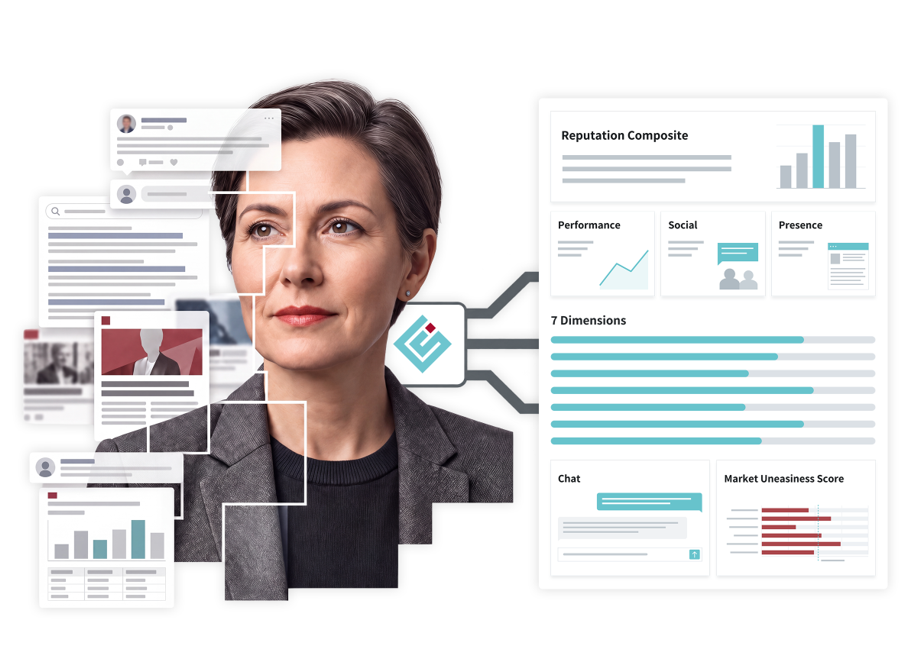
Today, our system aggregates 72 data points for each individual leader. We call it C-Score.ai – Executive Reputation Intelligence.
These 72 data points are consolidated into seven dimensions, for example Leadership Excellence, Community Engagement and Digital Perception. Each dimension can be examined individually, compared with benchmarks of executives from the same or different industries, and addressed through targeted development programs.
This is also a good example of where the real productivity gains from AI can be found: in processes that could not previously be automated and required enormous amounts of data and repetitive, labor-intensive intelligence work. AI has made these processes scalable, although the evidence-gathering and normalization is heavy on compute .
Why we chose BlueCallom
Our first version of C-Score.ai was an in-house, ChatGPT-based prototype. Moving it to a professional development and runtime environment was an important decision, driven by three considerations.
The first was auditability. Executive reputation benchmarks are highly sensitive. We cannot afford to have fabricated or unverified information influencing the scoring. Every result must be based on evidence that can be traced and verified. A professional runtime environment provides the foundation for controlling this process.
The second was operational stability. Building directly on rapidly evolving AI services exposes developers to changing models, experimentation, security concerns, pricing adjustments and other uncertainties. BlueCallom provides a protective layer around our system and helps us maintain a more stable, controlled environment.
The third was accessibility. BlueCallom developed a kiosk system that allows our contracted clients to generate C-Score.ai benchmarks for themselves or members of their executive teams whenever required. This transforms a complex intelligence process into a professional service that can be accessed without repeatedly initiating a manual research project.
A reputation model with roots in ancient philosophy
C-Score.ai examines three fundamental aspects of executive reputation: how Leadership Excellence is perceived, how executives are regarded by employees and their wider social and community environment, and how they appear in the media and digital media.
Although the technology is new, the underlying thinking is more than two thousand years old. Our approach draws on Aristotle’s concepts of logos, pathos and ethos; Jürgen Habermas’s model of the three worlds; and the work of Marc Eisenegger at the University of Zurich, who further refined this thinking. These theoretical foundations have been translated into C-Score.ai, a sophisticated intelligence system running on the BlueCallom platform.
The objective is not simply to produce another ranking of executives. It is to provide a structured, evidence-based understanding of how Leadership Excellence translates into reputation – and where improvements are possible.
From a static benchmark to an intelligent conversation
One of the most significant developments made possible by AI is the transition from a static report to an interactive intelligence system. The real advance lies in the ability to interrogate the findings through a chat feature. An executive might ask: “We had to lay off a significant number of people, and the media reported on it extensively. Did that damage my reputation?”
This is not a question that can be answered reliably through a general sentiment analysis or a collection of media clippings. It requires an examination of different sources, the context in which the event occurred, and the extent to which criticism of a company’s decisions has affected perceptions of the individual executive. C-Score.ai allows executives to explore precisely these relationships.
The system can also measure an executive’s Reputation in relation to his Market Uneasiness Score. While the Reputation Composite reflects the executive’s overall reputation standing, their Market Uneasiness Score captures signals of concern or uncertainty surrounding the executive’s leadership.
Consider an executive responsible for announcing substantial layoffs. Negative media coverage of the restructuring does not necessarily mean that the executive’s personal reputation has deteriorated to the same degree. The markets may still trust the person’s leadership and regard the decision as necessary. Alternatively, the announcement may reinforce existing doubts about their judgement, competence or ability to lead. Distinguishing between these situations is essential if executives and their communications teams want to act on evidence rather than assumptions.
The difference between performance and perception
For many executives, the most interesting question is how they compare with people who venture for similar positions, influence and business opportunities.
- Is there a gap between their actual contribution to company success and the recognition they receive?
- Does their external reputation reflect the quality of their leadership?
- Are their strengths recognized by the audiences whose trust matters most?
- And how does their reputation compare with that of executives in another industry, particularly if they are considering a career transition?
These questions are central to the work we do at CEO Positions. C-Score.ai provides the evidence-based starting point. It shows where an executive stands, where gaps and risks may exist, and how peers perform. The subsequent work focuses on what the executive can actually do with that knowledge.
Through company leadership programs and our Personal Positioning Day, we translate benchmark findings into positioning decisions and practical action. Depending on the executive’s situation, the outcomes include a vision board, key messages, a positioning lighthouse and a concept-to-go for the following six months.
The benchmark is therefore not the final product. Its real value lies in the decisions and actions it enables.
AI creates value when intelligence becomes actionable
The experience of developing C-Score.ai has reinforced an important lesson about AI adoption.
Productivity does not necessarily come from making existing tasks a little faster. The greater opportunity lies in fundamentally changing processes that were previously too labour-intensive, expensive or complex to scale.
In our case, AI has made it possible to turn thousands of pieces of qualitative information into structured, comparable executive reputation intelligence. BlueCallom has helped us move this capability from an experimental prototype into a professional operational environment.
But neither the technology nor the benchmark is an end in itself. The ultimate goal is to help C-Level Executives make better decisions about where to invest their time, attention and resources – and to understand whether those investments are strengthening their reputation.
Susanne Mueller Zantop
Founder, CEO Positions AG | C-Score.ai
